Friday, May 23, 2008

On the "Love" of Guns, and the Role of Private Security

I have received quite a few responses to the recent post Range Day Report in the various forms of email, comments and other -- most laudatory, some derogative. One email I received sought to take me to task for the "love" I displayed for my Smith and Wesson 686. Here is what I posted about that weapon:
The SW686 I had shot and trained with many times before. I stopped counting the rounds through it at 15,000. Purchased in February 1994, this revolver is hands down my favorite weapon in the world. I carried it on and off duty for over a decade and it bears the scars of holster and duty wear as badges of honor. This is the weapon I trusted with my life during trips into mortal danger along the Mexican border and El Paso's barrios. Since my wife and I were married, this is the weapon that resides on my wife's night stand when I am not carrying on duty. A joke my friends are tired of hearing is that soon after we were married, my wife stated that if I started calling it by a pet name she was calling the guys in the white jackets... The SW686 remains unnamed as I don't relish a trip to the looney bin.

The cumulative effect of thousands of rounds has rendered the trigger stroke, already smooth from the factory, a silky smooth experience. I installed pachmayr synthetic grips soon after purchase both for increased control and to mitigate the hardship of carry on the original rosewood grips. Other than that, the SW686 is stock from the factory.

If I am forced to pick one handgun to carry on duty, the SW686 is it. That being the case, I qualified with it first.


The quote in bold is the part that seems to have elicited the most strident objections. The email I mentioned rambled monotonously about my "love affair" with an inanimate object.

Please.

That charge is the result of a juvenile mind unable to raise itself from the gutter of prurient thought.

True, I fawn over this weapon. I trust it. Why? Because of the over 15,000 times I have fired it, it has never failed. I know that if I am in a position that requires use of a weapon to protect the lives of the people I love, that weapon will perform the task for which it was created. At various times over the years my life and those of my family depended on having a weapon that would function as it is intended.

Thomas Jefferson once wrote to George Washington, "One loves to possess arms, though they hope never to have occasion for them." That sums up exactly my "love" for that weapon, and the attraction I have regarding my collection of various weapons. I think I'll go with a couple Founding Fathers and presidents over the addled sophomoric objections of a misinformed bloviator.

Another would-be commenter sought to demean the part I wrote about carrying the SW686 "along the Mexican border and El Paso's barrios." He tried to use the term "security guard" as a pejorative. That I have worked private security is obvious, as I stated in the article that I was taking the Handgun Permit Carry course and the Armed Security course. In fact, I stated that taking the security course was the reason I qualified with two weapons -- so that I could carry either on duty.

What the commenter did not know, and what I do not believe I have written on this blog before, is that I have also served my time as a sworn peace officer. So yes, much of my time carrying the SW686 was as a private security officer in addition to the time I carried it as a peace officer.

However, the slighting comments the commenter made about private security are ill-informed and yet pervasive in our society. Many private security firms are guilty of only performing to the parameters of the contract under which they operate. Many public encounters are with the "warm bodies" that are hired to fulfill these "lowest bid" contracts. Unfortunately, these instances are the ones most often brought to mind when the subject of private security is raised.

The truth behind the subject is different. When one hears of government officials speak of "first responders" the professionals brought to mind are police, fire fighters and emergency medical services. The fact is that the first people on the scene are most often regular citizens and private security. During the September 11, 2001 attacks the first professionals to organize a response to the life taking situation were security guards. The most famous of these was Rick Rescorla who, as head of Morgan Stanley's security, saved thousands of lives during the disaster and died looking for stragglers when WTC 2 collapsed with him in it. Rescorla is also famous for being a member of General Hal Moore's unit that was portrayed in We Were Soldiers Once...and Young: Ia Drang--The Battle That Changed the War in Vietnam. The story of his sacrifice was documented in Heart of A Soldier A Story of Live, Heroism, and September 11th by James B. Stewart.

Rescorla's story is not the only one of private security officers saving lives in the WTC attacks. Another is of Esmerlin Salcedo:
World Trade Center security guard Esmerlin Salcedo was in no peril on the day of the attack since he was attending a computer class at a safe distance away. But when he heard the first strike, he raced from his class to his desk at the command center on the B-1 level. He walked fellow worker Roselyn Braud to an open exit and told her to run for her life. The last time he was seen he was helping another guard to safety. The 36-year-old father of four earned $10.51 an hour. He has an $80,000 life insurance policy but, according to the New York Times, his survivors may not be eligible for survivor's benefits because he wasn't officially “on duty.”
Salcedo was not "on duty" but his sense of duty led him to give his lives for others.

Just a Rent-a-Cop.

The stories are there, but only if you dig deep for them. In another post I hope to write about the environment wherein security guards and officers must work, an environment created by lack of pay, lack of training, and lack of support and recognition -- most of which are caused by low bid finances and "warm body" mindsets in the private security sector and the public in general.

So, when that commenter sought to insult me for having been a security guard he failed. I simply considered the source.

Yeah, I love my gun -- for what it does to protect my family. And I am proud to have served as a peace officer and as a private security officer. The next time you see a security officer at a bank or store, think about just who it is the bad guys are going to target first, and who protects you from those bad guys if you have not availed yourself of your state's carry laws. Remember, the security officer is there on location and in high profile uniform, there when the "fit hits the shan." The guys at Emergency 911 are minutes away -- and when the bad guys hit seconds matter.

Friday, May 16, 2008

Range Day Report

Last week I promised a report on the Tennessee Handgun Carry Permit course I took and my experience at the range for qualification. I'm going to start with the last day first: Range Day.

I was not only qualifying for the Carry Permit, I was also qualifying for an Armed Security license. Unlike the Carry Permit that allows the bearer to carry whatever handgun one wishes, the security license is weapon specific: if you want to carry it you have to qualify with it. That being the case I ponied up the extra $20 range fee and qualified with a Smith and Wesson 686 revolver (.38 Spl and .357 Magnum) and a p944dc Ruger pistol (.40 SW).

The SW686 I had shot and trained with many times before. I stopped counting the rounds through it at 15,000. Purchased in February 1994, this revolver is hands down my favorite weapon in the world. I carried it on and off duty for over a decade and it bears the scars of holster and duty wear as badges of honor. This is the weapon I trusted with my life during trips into mortal danger along the Mexican border and El Paso's barrios. Since my wife and I were married, this is the weapon that resides on my wife's night stand when I am not carrying on duty. A joke my friends are tired of hearing is that soon after we were married, my wife stated that if I started calling it by a pet name she was calling the guys in the white jackets... The SW686 remains unnamed as I don't relish a trip to the looney bin.

The cumulative effect of thousands of rounds has rendered the trigger stroke, already smooth from the factory, a silky smooth experience. I installed pachmayr synthetic grips soon after purchase both for increased control and to mitigate the hardship of carry on the original rosewood grips. Other than that, the SW686 is stock from the factory.

If I am forced to pick one handgun to carry on duty, the SW686 is it. That being the case, I qualified with it first.

One thing a person going though J. Buford Tune's APPS instruction must have is endurance. The man can talk. And he loves to talk.

And talk some more.

And when you think he is done talking, just prepare to listen some more.

The class arrived at the meeting point in Smyrna, TN at 0800. The APPS instructors met us there and led us onto the National Guard weapons range at about 0830. From the time we assembled until about 1200 we listened to Buford lecture and instruct us on the workings of our handguns, the foibles inherent in each type of handgun (he dislikes striker fired weapons -- Glocks and their imitators -- intensely), proper footwork, proper stance/posture for close in handgun fighting, and why J. Buford Tune considers the Beretta 92f to be the finest fighting handgun ever made, if one wishes to carry a semi-auto pistol. It is his considered opinion from decades of experience that everyone should carry revolvers instead of "jam-o-matics" and that striker fired pistols are the bane of all good shooting principles.
I am in no way promoting this as the ultimate answer to how to fight with a handgun. Techniques differ from person to person and instructor to instructor. However, what was taught at this class works and enriched my personal knowledge base greatly. I don't know what else one can ask from a class or instructor.


For instance, Tune explains, "here is how to break down a pistol." He then disassembles a pistol, taking off the slide and removing the barrel and various components. After re-assembling the pistol, he then demonstrates "breaking down" a revolver by opening the cylinder. "See the difference?"

Point made, and to me, he was preaching to the choir.

After the class room time and a thirty minute lunch it was time for proper stance and draw stroke instruction. Here are the basics of a proper J. Buford Tune stance and drawstroke:
1) The initial position is facing the target/threat square on -- or "full frontal" if you want to call it that.
2) When the threat is recognized as requiring defense, pivot on the weak side foot and bring the strong side foot back (both feet should turn so that they point in the same direction), bring the weak hand in a fist to the upper pectoral area (as if blocking a punch), place the strong hang on the holstered weapon, and shout, "NO!" (See Lessons Learned below)
3) Draw the weapon and bring it up to the weak hand and hold the weapon against the upper pectoral in a two hand grip, weak hand fingers over strong hand fingers and weak hand thumb over strong hand thumb.

The weapon is ready to fire should the threat require. The technique utilizes the "point shooting" method for close in combat. During the second round of live fire one of the instructors working with our sub group demonstrated how close most street combat with guns occur by placing the palm of his hand about three inches from my nose.

That's close. Aiming is out of the question, and retention is vital. The technique APPS teaches emphasizes retention.

The retention techniques I had always used had the weapon held close against the upper waist, lower side area with only the strong hand, the weak hand being raised and used for blocking techniques.

The immediate thought I had was about how close to my face this weapon was going to fire...

We then continued with instruction on aimed fire from this stance should the threat not be contact close.
4) Using the weak arm/hand like "a robotic arm" to pivot with the elbow in contact and deriving support from the body, raise the weapon to eye level without moving the head.

Again, my thoughts went to how close the weapon would be firing to my face, especially with the pistol's slide coming back with each round, and right in front of my eyes! This and other factors were to play a part in my first few rounds on the firing line.

A point Tune made during this phase of instruction stuck in the back of my mind and would help me control my groupings during the aimed portion of firing: He likened the stance to that of the standing rifle marksmanship position, with the off hand elbow being supported by the body and the off hand supporting the forestock of the rifle. Decades ago I was on the rifle team at Eastern New Mexico University's ROTC program and had learned that stance during hours of dry fire at the behest of SGM Nick Gonzales. I had integrated that into my handgun technique in a stance very similar to the Modified Weaver over the years.

At about 1400 we made our way to the firing line. Here we received our final instructions:
1) On the line, the range master (Tune) would give a command; example, "On Command -- Fire One!" The instructors would then repeat the command, "On Command -- Fire One!" The shooters would then respond, "Fire One!" Then, the Range Master would give the command, "Fire!" At that time the shooters would draw and fire the requisite number of rounds.
2) We were told that the weapon must remain on target and ready to fire after having fire the requisite number of rounds until commanded to holster.
3) We were told that it was our responsibility to keep our weapons loaded at all times (Important!). During the time between having completed fire and when commanded to holster was when we were supposed to reload. The range master made sure to allow adequate reload time.

The first course of fire was from FIVE feet. When we moved to the five foot line I had visions of rounds bouncing back from the target. I checked and found, to my relief, that the backstop was loose soil. That left the target frames which were metal, but I was sure I would not hit those.

Then I remembered I was not alone on the line.

I started eyeballing the guys next to me trying to gage if THEY would hit the frames and create a ricochet...

Soon came the command to load and re-holster. I did so and started contemplating my paper target with malevolent thoughts.

"On COMMAND!" We fired about half the course in various rounds of between one and five shots. Again, I was using the SW686 (a revolver), but the guy to the left of me was using a Kimber of some sort (an expensive pistol). In addition to "fighting" the newly learned stance and dealing with the 686 going off just below my chin -- brass from the Kimber was hitting in the back of the head and neck!

There simply is no feeling like that of a just fired cartridge making its way down your collar and back.

Hot.

Next time I'm wearing a t-shirt under my regular shirt and I'm probably wearing my Stetson.

In the pic you can see two "flyers" next to the white outline circle, in the black and garnering full points, but still outside of the groupings. I'm pretty sure those were from that one shell going down my shirt...

Several times the instructor on our end approached me between rounds of fire to admonish me for allowing the weapon to move away from my chest. The technique requires a tight grip on the weapon close against the off hand pectoral for retention. I found it also helps accuracy in the point-shoot method. The instructor also inquired as to the ammo I was using -- I had purchased it (.38 +p FMJ Remington, as I recall) from APPS at the range. The 686 is a loud weapon. He thought I was using .357 Magnums.

We then moved back to ten feet where we used the aimed fire stance for the second half of fire. After fighting this new stance mentally, with the 686 mere inches in front of my eyes, I started acclimating to the new firing position. Again, the instructor was there to correct me -- move the weapon to eye level and do not "hunch" over the weapon or move the head at all. It was at this point that all the dry fire sessions at the ENMU-ROTC range came back. I settled in and started punching out the center of the target.

Next came the second round of qualifying for those shooting two weapons.
During this round I used the Ruger p944dc pistol I had purchased back in 2001 -- but had never fired. I've fired other pistols, and other Ruger pistols, but never this one. However, I was by now used to the new techniques being taught by APPS and was able to keep each round in the center of the target.

This time I was at the end of a much smaller firing line. The guy to my immediate left was a retired New York City police officer who is starting a new security agency here in Nashville. At the beginning of the course of fire I was in a quandary about how to reload my holstered pistol. He reminded me about the "tactical reload" -- something I had read and heard about but had never tried and that did not occur to me. I'm a revolver guy, remember...

After the course of fire was over, an instructor said my marksmanship was fine, but that I should now concentrate on the upper chest area and the lower abdomen area. The reasons were to avoid body armor and to deliver immediate incapacitating shots; the goal being to STOP the threat as quickly and as effectively as possible. The upper area targets the thorax, upper spinal column and a vital part of the lower brain. The lower area avoids the bottom of most armor, targets the lower spinal column and the pelvis. Rare is the individual that can operate with a shattered pelvis...

Lessons Learned

1) You can learn as much (More?) by listening to instruction about firing a weapon as you can by actually firing the weapon. I learned new methods of reloading a revolver without taking eyes off the target, that spare rounds for a revolver should be kept in the strong hand side -- a pistol on the weak hand side, advice about the kaBoom factor, the Tactical Reload as mentioned above...

2) Quality training time is never wasted time. Training stays with you always. Those hours of dry fire sessions with SGM Gonzales in Portales, NM are still paying off over two decades later. Much of what I learned from him was in what Tune was teaching here. When you find an instructor like this, do your best to be a sponge and soak up everything you can. I know I'm going back as finances allow for more at APPS.

3) Your weapon is your friend. Respect it, but don't fear it, and it will assist you in defending against the threats that abound in life. I had a distinct fear of firing so close to my eyes and face, but that fear was unfounded and I overcame it. Now I have much better skills in the use of my self defense tools and a better chance to survive deadly encounters.

4) The grips on the SW686 are too large for my hands. Tune examined how I was holding the revolver and recommended smaller, non-synthetic grips.
If you are in the Nashville area and you are looking for quality firearms and security training, I HIGHLY recommend APPS. They can be contacted at:
http://www.appstraining.com/
Telephone:
615-360-6002
FAX:
615-366-7374

Postal address:
Academy of Personal Protection and Security
336 Hill Ave.
Nashville, TN 37210


5) Sometimes one should just keep their mouth shut. At the end of the day, after several days of ten hour instruction and eight hour work nights, I was exhausted (that five hour energy stuff wears out after five hours, duh). Several of my fellow students congratulated me on my scores... My mind was in the mode of placing the credit to the instruction I had received from SGM Gonzales all those years ago as well as the instructors that day on the range. What came out was, "Yeah, I was on the rifle team once..." I wish I had just said thanks and had shut the hell up.

6) Simple is often better. Why yell, "NO! at the threat instead of "Stop!" or some other command? Tune stated that policed research had indicated that the simple command of "NO!" would cause almost EVERYONE to at least pause where other commands would not faze them. Why? It is thought that since "No" is one of the first words we learn, and is one of the few words to cause a conditioned response from our parents and others almost from birth, that most people are readily conditioned as a Pavlovian response to stop and examine what they are doing, or should not be doing. This response crosses just about every culture and language: No sounds the same in almost every language. The bottom line is that you want the threat to stop or at least give you time to ready your defense. Shouting "NO!" does that like no other command.

The most important lesson I garnered from the day on the range is about training: Train correctly, do it the same way every time, and do it often. I had a GREAT time and I'll be taking the Intermediate course at APPS as soon as possible.

Friday, April 18, 2008

Pilot Scapegoated

An Update on Did TSA Idiocy Cause Airline Gun Mishap?: The TSA and US Airways have predictably scapegoated the pilot whose firearm discharged on that US Airways flight last March.
(CNN) -- An US Airways pilot who aviation officials say accidentally fired his handgun in the cockpit during a flight will be fired, a spokesman for a flight officers group said.

The airline has begun the termination process for Capt. James Langenhahn, said Mike Karn, vice president of the Federal Flight Deck Officers Association.

Langenhahn told police that he was stowing his gun in the cockpit of a jet preparing to land in Charlotte, North Carolina, last month when it accidentally fired. The federal Transportation Security Administration is investigating the incident. (from CNN.com)


The item goes on to report that the FFDOA will try to fight the firing according to their spokesman.

The truth of the matter is that the holster the TSA requires Flight Deck Officers (FDO) to use is designed to cause a negligent discharge. The pilot, as related in the CNN item, states he was stowing the weapon when it discharged.

DUH!

Anytime the trigger of a double action weapon encounters an object, as it must in this stupidly designed holster, there is a very real danger of the weapon discharging. My opinion remains that the TSA wishes the FDO program to fail and is doing everything it can to attain that wish.

Also see: Today's Crime File News's entry on the topic.

Our entry from March 31, 2008.

Sunday, April 6, 2008

Keeping the Blogging Demon at Bay

My wife and I were discussing starting blogs as a means of income. She has the writing credentials -- I have the... Heck, I don't know what I have. Anyway, we've been exploring blogging and how some people are making a living or adding to their income (or wasting their time) over the past year or so.

Then this story explodes across the blogosphere:

Two weeks ago in North Lauderdale, Fla., funeral services were held for Russell Shaw, a prolific blogger on technology subjects who died at 60 of a heart attack. In December, another tech blogger, Marc Orchant, died at 50 of a massive coronary. A third, Om Malik, 41, survived a heart attack in December.

Other bloggers complain of weight loss or gain, sleep disorders, exhaustion and other maladies born of the nonstop strain of producing for a news and information cycle that is as always-on as the Internet.


Back in December I took the test and was found to be only 52% addicted. It may be time for another opinion -- hey, life and death may be at stake!

Hey, Ben... How's that problem working out for you?

But this is a serious thing. The good news for most of the blogosphere is that circumstances alleged to have created this deadly malady seems relegated to tech bloggers.
One of the most competitive categories is blogs about technology developments and news. They are in a vicious 24-hour competition to break company news, reveal new products and expose corporate gaffes.

To the victor go the ego points, and, potentially, the advertising. Bloggers for such sites are often paid for each post, though some are paid based on how many people read their material. They build that audience through scoops or volume or both.


I've pretty much limited my blogging to what I find interesting; Politics, the Redskins, and Chess. This blog started as a Correspondence Chess blog. I don't blog about tech stuff (Oh, Really?). I also don't do it for income.

So the question is this: Has blogging affected your lifestyle? Is that effect positive or negative? Four years ago people were not only noticing blog addiction as a problem, it had been studied extensively. The New York Times reported on this disorder at that time:
Blogging is a pastime for many, even a livelihood for a few. For some, it becomes an obsession. Such bloggers often feel compelled to write several times daily and feel anxious if they don't keep up. As they spend more time hunkered over their computers, they neglect family, friends and jobs. They blog at home, at work and on the road. They blog openly or sometimes, like Mr. Wiggins, quietly so as not to call attention to their habit.


The article relates anecdotes from several bloggers to illustrate their addiction and the symptoms that result:
Tony Pierce started his blog three years ago while in search of a distraction after breaking up with a girlfriend. ''In three years, I don't think I've missed a day,'' he said. Now Mr. Pierce's blog (www.tonypierce.com/blog/bloggy.htm), a chatty diary of Hollywood, writing and women in which truth sometimes mingles with fiction, averages 1,000 visitors a day.
''The pleasure response is twofold,'' he said. ''You can have instant gratification...''
''like most addictions, those feelings go away quickly. So I have to do it again and again.''

Where some frequent bloggers might label themselves merely ardent, Mr. Pierce is more realistic. ''I wouldn't call it dedicated, I would call it a problem,'' he said. ''If this were beer, I'd be an alcoholic.''
...
Mr. Pierce described the rush he gets from what he called ''the fix'' provided by his blog. ''The pleasure response is twofold,'' he said. ''You can have instant gratification; you're going to hear about something really good or bad instantly. And if I feel like I've written something good, it's enjoyable to go back and read it.''

And, he said, ''like most addictions, those feelings go away quickly. So I have to do it again and again.''


There is hope for those who notice the symptoms:
Suffering from a similar form of ''blog fatigue,'' Bill Barol, a freelance writer in Santa Monica, Calif., simply stopped altogether after four years of nearly constant blogging.

''It was starting to feel like work, and it was never supposed to be a job,'' Mr. Barol said. ''It was supposed to be an anti-job.''

Even with some 200 visitors to his blog each day, he has not posted to his blog since returning from a month of travel.
''It was supposed to be an anti-job.'' ''And the absence of posting feels like -- I don't know, laziness or something.''

Still, Mr. Barol said, he does not rule out a return to blogging someday.

''There is this seductive thing that happens, this kind of snowball-rolling-down-a-hill thing, where the sheer momentum of several years' posting becomes very keenly felt,'' he said. ''And the absence of posting feels like -- I don't know, laziness or something.''


Whoo, Boy. If I hear of any blogger intervention encounters I'm barricading the doors... Consider that fair warning!

Monday, March 31, 2008

Did TSA Idiocy Cause Airline Gun Mishap?


(h/t The Michael Bane Blog)
Last week this story caused a mini-sensation when a pilot that had qualified through the "Federal Flight Deck Officer" program had an "accidental discharge." Take a look at the weapon and holster the program MANDATES for each FFDO. A LOCK through the TRIGGER GUARD?

ARE YOU KIDDING ME?

I've been carrying a handgun for over 20 years now, and if ANYONE mandated that I should put ANYTHING in the trigger guard of MY weapon I would have immediately looked into seeing that THEY no longer carried a weapon. Anyone who is knowledgeable about firearms knows that the trigger is to NEVER be TOUCHED unless the weapon is to be fired SOON, as in IMMEDIATELY. This holster requires that a metal bar be threaded through the trigger guard of a double action pistol and worn on the hip. I'm FLOORED to think that this is the FIRST time something like this has happened.

And that lock that TSA mandates be threaded through the holster? It isn't even secure. Here's a video on how to pick it in seconds:


Paul Huebl of CrimeFileNews broke the story of how this holster and weapon were made for mishap back in December 2007.
It was only a matter of time before there’d be an accidental, non-negligent discharge of a Federal Flight Deck Officer’s weapon. Saturday a U.S. Airways pilot’s gun discharged on Flight 1536, which left Denver at approximately 6:45am and arrived in Charlotte at approximately 11:51am. The Airbus A319 plane landed safely and thankfully none of the flight’s 124 passengers or five crew members was injured

The insane procedures required by the TSA demands that our pilots to lock and then un-lock their .40 side arms was and is a solid recipe for disaster. Did the TSA deliberately create this bizarre and unconventional Rube Goldberg firearm retention system hoping for this result? The sordid history of the FAA and TSA’s total resistance to the concept of arming pilots to protect Americans is in itself a scandal.

Putting a gun into a holster and then threading a padlock through the trigger and trigger-guard is required every time the pilots enter or leave the cockpit. This kind of silliness has never been forced on any law enforcement or security officers anywhere in the world until now. Before this holster padlock procedure pilots with guns were forced to carry them around in a cumbersome 22 pound vault. The vault caused problems in the confined space of most cockpits.

FFDO pilots need to carry their side arms in conventional concealed holsters and there is no reason for the unnecessary handling of their firearms in the cockpits.


Huebl then made a video explaining how the discharge probably happened.


I have to say, this reeks of someone wanting to sabotage the process of arming pilots. No one can be THIS stupid, can they?

Here's a bit of a clue from the CBS item at the time:
The TSA initially opposed the Flight Deck Officer program to arm and train cockpit personnel. Agency officials worried that introducing a weapon to commercial flights was dangerous and that other security improvements made it unnecessary. Congress and pilots backed the program.

"The TSA has never been real supportive of this program," said Mike Boyd, who runs the Colorado-based aviation consulting firm The Boyd Group. "It's something I think Congress kind of put on them."


Stupidity or deliberate sabotage?

Thursday, March 27, 2008

Chess: My Events Update

It has been a while since I updated my correspondence chess events status.
-I may be closing in on my first ICCF event title in four tries.
-I'm currently at the top in what is probably my last ICC correspondence event, but that could change.
-I haven't started another USCF event as certain political events must be resolved within the Federation... Or I'll cease to be a member.
-I've joined the CCLA and CJA.

ICCF

109In the first event I participated in at ICCF, WS/O/109, I long ago finished my games. However, there is still one game going; Deren, Marcin vs. Kýhos, Alois. If Deren wins, he and I are tied with Kýhos for 2nd-4th. If they draw or Kýhos wins, I have a clear 3rd after Pötz and Kýhos. In any case, I can do no worse than 3rd. Pötz is the clear winner after his recent result over Deren. I blogged about several games in this event; Barzaghi - Owens, Owens - Thomas, Kýhos - Owens, and Pötz - Owens. The Pötz loss made me swear off the Kalashnikov, at least for Correspondence play.
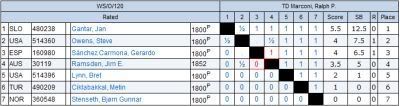
120In event WS/O/120, Jan Gantar has won 1st place. I am in a fight for 2nd place with Gerardo Sánchez Carmona. As the chart shows we are tied with four points, he having attained four wins and I having three wins and two draws. Ours is the last game in the event to be resolved and I can only capture 2nd with a win. We are almost sixty moves into a Caro-Kann Gurgenidze in which as Black I am up the Exchange. Sánchez Carmona allowed the exchange for a passed d pawn, but I was able to remove that pawn. We are in the early stages of the end game and I anticipate a full point and 2nd place in this event. I have not yet posted analysis of any of these games.

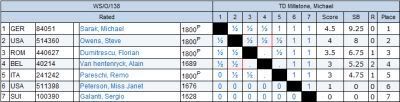
138In event WS/O/138, I have finished all my games with two wins and four draws. I was disappointed with my performance in this event as in at least three of my draws I had a clear advantage but was unable to press home the win. Once again, I can finish as high as my current 2nd place standing. The first five positions are still to be determined depending on the results of the last two remaining games. I have not yet posted analysis of any of the games in this event. I tried 1...e5 in my game versus Dumitrescu which became a Ruy Lopez Berlin. I entered the end game with a strong advantage but was outplayed in the end game and accepted a draw. Against Sarak I played the Black side of a 1.Nf3 game that turned into an English Symmetrical without g3. I chose a "Dragon" style set up and White responded with the Maroczy Bind. White sacced the Exchange for two connected passed pawns (d and c) that I was later obligated to return the exchange to remove. In the end game, White ended up two pawns, doubled on the g file, and I accepted a draw offer on the 78th move. Against Van henteryck, I played the White side of a Reti English and had a significant initiative late into the game. My pieces were well placed and had scope, but Black was well positioned for defense and had a passed c pawn. This game was tortuously drawn out with Black often moving only once every three or four weeks and several times coming within hours of a time forfeit. I couldn't see a definitive win and accepted a draw on the 35th move. Against Pareschi I played the Black side if an uninspired closed Sicilian (3.Bc4) that ended in a 40 move draw.

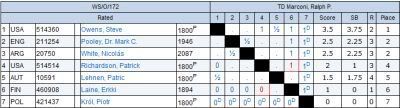
172In event WS/O/172, I am cautiously optimistic about my chances. I am currently in the lead with 3.5 points (three wins and a draw). In the one draw (Owens - Lehnen) I played a Reti English as White and allowed the game to get drawish much too quickly. Richardson - Owens saw White sac a piece for three pawns early in the middle game. I sacced the Exchange to double his f pawn and open up his King side around move 25. The Black Queen and Knight moved quickly on the weakened King side and White resigned after move 31. In Laine - Owens I returned to my favorite Caro-Kann. Bucking the trend, Laine chose the Classical variation. After White castled long, Black found a very strong attack on the c file and White resigned after move 26. Owens - Pooley is still on going in a Caro Kann Advance variation that is in the middle game. I think I have a strong advantage in this one. Owens - White is in the end game of a Reti English where I am up three clear pawns, two being connected passed pawns. The Queens are still on the board so the outcome is in doubt, but I retain a very strong advantage.

ICC

I have one game in one event still going at ICC. I think this will be the last ICC correspondence event for me. Twice my opponent has over stepped the time limits and has been allowed to continue. One game, as White in the London System, where I had to fight back from a tactical blunder very early ended in a draw. The other, where I am Black in a Reti English that transposed to a conventional KID, is on going. We're just entering the end game and I think I have a decent initiative. In the event, I have scored four out of five points with one point to be determined. As the event page has not been updated I'm not sure where I stand; win, place, show, or last. Blogged games from my last two ICC correspondence events are here, here, here, here, and here.

USCF

Both of the events (USCF/WS/07WM27 and USCF/WS/07WM41) I participated in at USCF Correspondence have finished. The only game I blogged is here.

ORGANIZATIONS

I've joined both the Correspondence Chess League of America and Chess Journalists of America. I joined CCLA as one must be a member of USCF or CCLA to play in ICCF events. There are certain circumstances that may prompt me to leave the USCF when my annual membership is due this summer. CCLA is also inexpensive. I joined CJA since this and ChessUSA place me in a "journalist" type capacity. I encourage ALL bloggers to join CJA. The fee is insignificant ($10 per year) and if a sizable contingent of bloggers join and agree to abide by the CJA code of ethics I believe bloggers will gain better acceptance both from the size of the affiliated blogging community and the ethical quality of the resulting blogs that adhere to the code.

Saturday, March 22, 2008

If You Want To Send Hate Mail...


I made my email address available (it isn't listed on the blog page itself, but the address is obtainable to the enterprising from the page with only a couple clicks of a mouse) so that I could interact with those who wished to objectively discuss things, but preferred to do so in private instead of the "comments" area. I prefer having objective comments placed in the comments area, but I understand if some wish to email.

I've received a few nice comments in email, and loads of others as typified by the following:
Subject hey, ####head
@aol.com to me

why do you obsess on obama's preacher? got nuthing else to write about. how about soem more s####y excuses for chess games, or more racist redskin footbal talk. yer an idiot. #### you. obama/malcolm x 08


As they go, this one is trite to the point of absurdity, and I have received many more that are very imaginative and more curiously constructed. I don't mind, really, as some of them provide a delightful diversion from the toils of daily life. That leads to my request; if you must send this type of missive, please make it interesting.

Here's a hint: Scatological, anatomical, and parentage aspersions do not automagically translate to riveting prose.